- The Macroeconomic Landscape: Foundations for Investment in 2026
- Investor Taxonomy: Identifying Your Profile in the Salvadoran Market
- In-Depth Analysis of Investment Programs in El Salvador
- Comprehensive Comparative Table: Investment Programs in El Salvador (2026)
- Strategic Conclusion: Weaving Your 2026 Investment Strategy
The investment landscape in El Salvador has been radically transformed, positioning the country as a unique destination in Central America. With a combination of aggressive government incentives, the disruptive innovation of the Bitcoin ecosystem, and a robust private financial sector, opportunities for investors have never been more diverse or accessible. This definitive guide thoroughly analyzes every option available in 2026, providing you with the crucial knowledge to identify the program that best aligns with your risk profile and financial goals, enabling you to make an informed and strategic decision.
In addition to traditional investment programs like real estate and energy, digital service platforms are emerging as attractive opportunities in El Salvador. A great example is Carvi, a local platform often described as the “Airbnb for cars.” Carvi allows vehicle owners to rent their cars online while providing tourists and residents with flexible mobility, insurance included, and no paperwork. This type of platform demonstrates how digital services can complement traditional investment avenues.
👉 Discover how Carvi is transforming mobility and creating investment opportunities — visit carvi
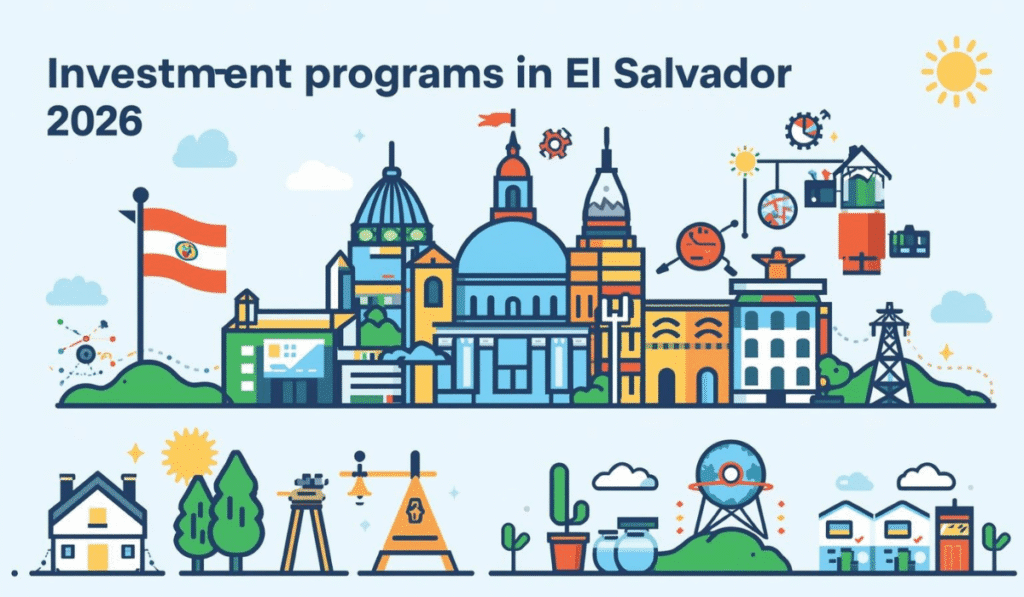
The Macroeconomic Landscape: Foundations for Investment in 2026
To contextualize the investment programs in El Salvador, it is imperative to analyze the fundamentals that support them. The country doesn’t just offer incentives; it’s building a platform for long-term growth.
- Stability and Sustained Growth: According to projections from the International Monetary Fund (IMF), the Salvadoran economy maintains a stable growth rate, consolidating after the post-pandemic years. This environment of relative macroeconomic stability reduces uncertainty for medium and long-term investments.
- Robust Legal Framework: The Investment Promotion Law has been supplemented with specific decrees that clarify its application. Most relevant for 2026 is the evolution of jurisprudence and procedures, offering greater legal security to foreign investors. The independence of the judicial system in resolving commercial disputes has been a focal point for continuous improvement.
- Critical Infrastructure in Development: Landmark projects like the modernization of the Port of La Unión and the expansion of the logistical capacity of the Monseñor Óscar Arnulfo Romero International Airport are creating efficient trade corridors. Investing in a country with constantly improving infrastructure provides a future competitive advantage.
- The Bitcoin Factor: Ecosystem Maturation: Five years after its adoption, the Bitcoin and blockchain ecosystem has transitioned from initial speculation to practical application. By 2026, a network of businesses accepting crypto exists, a more defined regulatory framework for Virtual Asset Service Providers (VASPs), and a solidified generation of developers and entrepreneurs. This attracts a very specific type of investment: technological venture capital.
Investor Taxonomy: Identifying Your Profile in the Salvadoran Market
Not all investment programs in El Salvador are for everyone. Before analyzing them, it’s crucial to place yourself in one of these profiles:
- The Conservative Investor: Seeks to preserve their capital. Prioritizes security over profitability. Their time horizon can be short or medium-term, and they value liquidity.
- The Growth Investor (Moderate): Accepts moderate risk in exchange for returns superior to traditional products. Usually has a medium-term investment horizon (3-7 years) and is interested in real development projects.
- The Aggressive Investor (Speculative/Visionary): Seeks multiplier returns. Assumes high risk and low liquidity, hoping to participate in the success of disruptive sectors. Their horizon is long-term.

In-Depth Analysis of Investment Programs in El Salvador
1. Flagship Government Program: The Investment Promotion Law and Its Mechanisms
This is not a single program, but an umbrella under which various investment programs in El Salvador are executed. Its detailed understanding is fundamental.
- Application Mechanism and Eligibility:
- Process: The investor must submit a formal application to PROESA, accompanied by a detailed business plan, feasibility studies, and financial projections. PROESA acts as a facilitator and guide throughout the process.
- Approval Criteria: It is not automatic. The project must demonstrate:
- Substantial generation of quality employment.
- Transfer of technology or know-how.
- Positive impact on exports or import substitution.
- Development of priority geographic zones (the country’s interior).
- Stratified Tax Benefits:
- Exemption Scale: Benefits are not binary. They are tiered based on the investment amount and location.
- Investments over $10 million can access a full income tax exemption for 15 years.
- Investments between $2 and $10 million can obtain 80% to 100% exemptions for periods of 10 to 15 years.
- Investments in free trade zones receive additional exemptions.
- Tariff Exemption: Applicable to the import of machinery, equipment, raw materials, and construction materials not produced locally.
- Exemption Scale: Benefits are not binary. They are tiered based on the investment amount and location.
- Breakdown of Priority Sectors:
- Tourism: Not just hotels. Includes ecotourism, health tourism, marina development, and sustainable resorts.
- Renewable Energy: Focus on solar, wind, geothermal, and biomass projects. The country seeks energy independence, creating an environment of guaranteed demand.
- Logistics: Leveraging the geo-strategic position, distribution centers, logistics warehouses, and multimodal transport services are incentivized.
- Agro-industry: With a focus on added value. Basic agriculture is not incentivized, but rather the processing, packaging, and export of agri-food products.

2. The Bitcoin Ecosystem: Beyond the Headlines
The landscape for 2026 has matured, offering more structured investment avenues than simply buying the cryptocurrency.
- The Volcan Bonds (Bitcoin Bonds): Current Status in 2026:
- Mechanics: These are sovereign bonds issued by the Government of El Salvador, with a 10-year term and a 6.5% coupon. Half of the funds are allocated to building infrastructure for “Bitcoin City” (a city powered by geothermal energy from the volcano), and the other half is used to buy Bitcoin.
- Source of Profit: Investors receive 6.5% annually, but the main gain comes from the anticipated appreciation of Bitcoin. At maturity, the government is expected to sell a portion of the accumulated Bitcoin and distribute the capital gains among bondholders.
- Real Risk: This is a high-risk product. The risk is not only Bitcoin’s volatility but also the country risk and the execution risk of the “Bitcoin City” project. Its value is directly tied to the success of the government’s economic model.
- Venture Capital in Blockchain and FinTech:
- Landscape: El Salvador has become a magnet for crypto entrepreneurs. This has given rise to a new class of investment programs in El Salvador: specialized venture capital funds.
- Examples of Opportunities:
- Infrastructure Startups: Companies developing custody wallets, security solutions, or APIs for Lightning Network payment integration.
- Decentralized Applications (dApps): Projects building on platforms like Stacks or RSK, which bring smart contract functionality to Bitcoin.
- Investment Path: The way to access this is not by buying the startup’s token (highly speculative), but by investing in the venture capital fund that, in turn, invests in a portfolio of these companies. This diversifies the risk.
- Direct Investment in “Bitcoin-Friendly” Businesses:
- Opportunity: Investing in the real economy that has emerged around the ecosystem: hostels, cafes, coworking spaces, and services specifically aimed at the “digital nomads” and crypto-investors arriving in the country.
- Advantage: This is a more tangible investment, with cash flows in US dollars, but benefiting from the marketing and tourism generated by the Bitcoin policy.

3. Private Programs: From Banking Tradition to the Vanguard of Venture Capital
These investment programs in El Salvador operate with purely market-driven logic and offer different levels of exposure.
- Private Banking Investment Funds (Technical Analysis):
- Types of Funds:
- Fixed Income Funds: Invest primarily in Salvadoran public and corporate debt. Low risk, low return. Ideal for the conservative profile.
- Equity Funds: Invest in stocks of companies listed on the El Salvador Stock Exchange. Moderate risk.
- International Mixed Funds: The most interesting. They allow a local investor to diversify their portfolio globally through the bank, investing in indices like the S&P 500 or European bond funds.
- Fees: It is critical to analyze the Total Expense Ratio (TER), which can range from 1.5% to 3% annually, directly impacting net returns.
- Types of Funds:
- Private Equity and Venture Capital: The Growth Engine:
- Key Differentiation:
- Venture Capital (VC): Invests in startup companies in early stages (Seed, Series A). High risk, potential for exponential returns.
- Private Equity (PE): Invests in established companies that need capital to expand, buy back shares, or make acquisitions. Medium-high risk, high but less exponential return than VC.
- Investment Structure: These funds operate under the “limited partnership” model. The investors (limited partners) provide the capital, and the fund manager (general partner) manages the investments in exchange for a management fee and a percentage of the profits (“carried interest”, typically 20%).
- Capital Commitment: The investment is not liquid. The investor commits to an amount that will be “called” by the manager over several years as opportunities are found.
- Key Differentiation:
- Real Estate Trusts (Local REITs or FITES):
- Operation: A developer creates a trust to finance a specific project (e.g., a luxury apartment building). Investors buy units of the trust.
- Income Flow: Profit isn’t only made from the final sale. During the leasing phase, rental income is distributed periodically among investors.
- Specific Risk: Pre-sale risk (not all units are sold), construction cost overrun risk, and market risk (oversaturation of the real estate supply).

Comprehensive Comparative Table: Investment Programs in El Salvador (2026)
| Program | Type | Approx. Min. Amount | Term | Expected Return | Risk Level | Liquidity | Ideal Investor Profile |
|---|---|---|---|---|---|---|---|
| Promotion Law (PROESA) | Government | $100,000 – $5M+ | Long (5-15 yrs) | 12% – 20%+ p.a. | Moderate | Very Low | Growth (Moderate) |
| Volcan Bonds | Government (Debt) | $1,000 (est.) | 10 years | 6.5% + Bitcoin Appreciation | High | Low (sec. market) | Aggressive / Visionary |
| Bank Funds (Fixed Income) | Private | $500 – $1,000 | Short/Medium | 3% – 6% p.a. | Low | High | Conservative |
| Bank Funds (Int. Mixed) | Private | $1,000 – $5,000 | Medium/Long | 7% – 10% p.a. | Moderate | Medium | Conservative / Growth |
| Venture Capital (Tech) | Private | $50,000 – $100,000 | Long (7-10 yrs) | 25%+ p.a. (volatile) | Very High | Almost None | Aggressive |
| Real Estate Trust | Private | $25,000 – $100,000 | Medium/Long (3-7 yrs) | 15% – 25% total (IRR) | Moderate-High | Low | Growth |
Digital innovation is reshaping how investors can participate in local markets. Startups like Carvi show how platforms connecting local resources with tourism demand create new revenue streams. For investors exploring programs in El Salvador, understanding these digital marketplaces can offer scalable, low-risk opportunities.
👉 Visit Carvi to explore a successful digital service model in El Salvador.
Strategic Conclusion: Weaving Your 2026 Investment Strategy
The Salvadoran market is no longer a single bet. It offers a spectrum of investment programs in El Salvador broad enough to build a diversified portfolio.
- Strategy for the Pragmatic Investor: A balanced portfolio could include an international bank fund (as a conservative base), a participation in a renewable energy project under the Promotion Law (for stable growth), and a small allocation of risk capital in a VC fund (for the pursuit of asymmetric returns).
- Due Diligence is Non-Negotiable:
- Legal Verification: Hire a local law firm to verify property titles, contracts, and the solvency of partners.
- Financial Audit: In private projects, demand audited financial statements.
- Manager Due Diligence: In VC or PE funds, investigate the track record of the management team. What other companies have they funded? What is their success rate?
The time to act is now. The ecosystem is in a maturation phase where opportunities are clear and serious players are consolidating. Begin your journey by contacting PROESA for a no-cost consultation and requesting the investment memorandums from private funds that align with your strategy.
Expanded Disclaimer: The information presented is for educational purposes and represents a general market overview for 2026. It does not constitute a recommendation to buy or sell any specific asset. Returns are estimates and do not guarantee future results. Risks include, but are not limited to: total loss of capital, extreme market volatility, unforeseen regulatory changes, political risk, liquidity risk, and counterparty risk. Consultation with independent financial, legal, and tax advisors is highly recommended before making any investment. The author and publisher are not responsible for investment decisions made based on this content.
Share this content: